
What education marketing is
Education marketing is every step that helps a family or a student find your school, college or university, trust it and join. A parent hears your name, searches for it, reads the website, checks the reviews, visits and applies. Each step is education marketing, and each one can lose them.
It looks like normal marketing from the outside. Three things make it different. The decision is big and slow. People ask others they trust before they ask you. And the year runs on a calendar: open days, applications, results, term start. Miss the date and you wait a year.
Who you are marketing to
| Provider | Who decides | What they check first |
|---|---|---|
| Primary school | Parents and carers | Distance, ratings, how children are looked after |
| Secondary school | Parents, and the child | Results, subjects, travel, the feel of the place |
| Private school | Parents, often both | Fees and what they buy, class size, results, bursaries |
| College | The student, with parents | Courses, entry grades, where it leads, travel |
| University | The applicant, with parents and teachers | Course content, entry requirements, fees, student life |
Write down the group you most want, and put one sentence under it: “They should choose us over the next provider because…”. That sentence is the spine of your education marketing. Make it specific and true. “Small classes” is vague. “No more than 18 pupils in a class” is clear, if it is.
The three jobs of education marketing
- Be found. When someone searches for your name, your subject or “schools near me”, your page shows up.
- Be trusted. The page tells the truth, shows real people and has reviews from families who joined.
- Be easy to join. Dates, fees and how to apply are on the page, and one clear button says what to do next.
Every channel you pick should help with one of these jobs. If it does not, skip it for now.
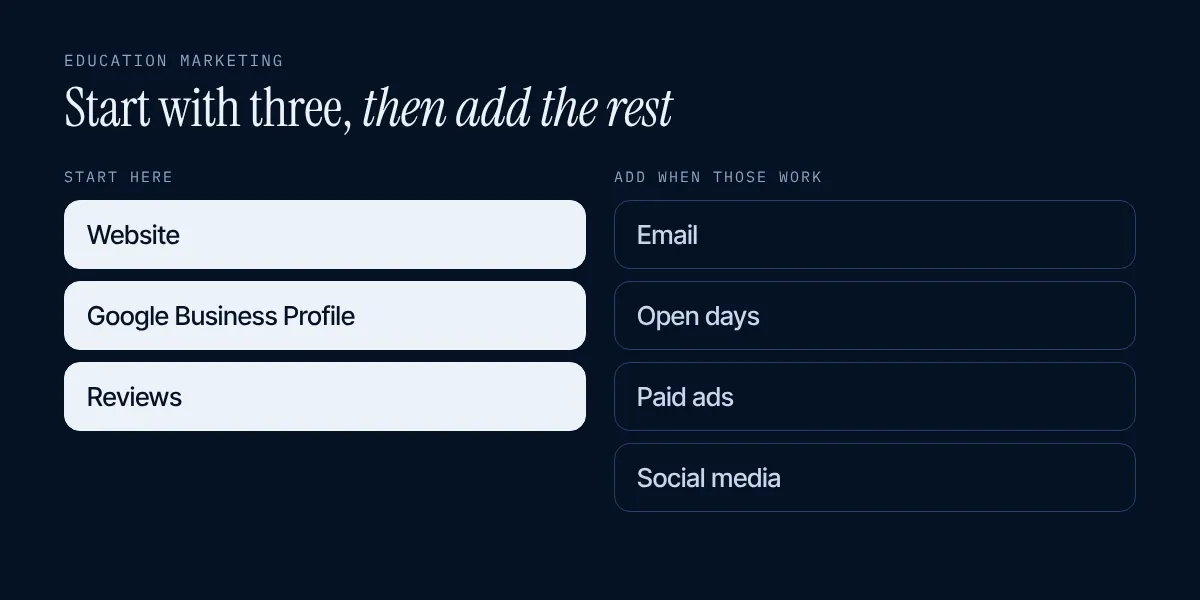
Start here: website, Google profile, reviews
Your website is where every other step ends. A parent who hears about you at the gate looks you up on a phone that evening. Give them admissions details, open day dates, real photos and one next step on every page. Check it on a phone, and check the speed: a good page shows its main content in 2.5 seconds or less, reacts in 200 milliseconds or less and shifts by 0.1 or less on web.dev.
Then claim your Google Business Profile. Google ranks local results on relevance, distance and prominence according to its help page. You cannot change distance, but you can change how complete your profile is and how many people say good things about you. Use your real name, as Google’s guidelines ask.
Finally, ask for reviews. Ask happy families, ask at the right moment, and reply to every review in a calm, polite voice.
Content that answers real questions
Families type real questions into Google. “What are the fees?” “How do I apply for a Year 7 place?” “Is there a bus?” Each question is a page you can write. Answer it in the first two lines, then add detail and a clear next step.
Google asks for helpful, reliable, people-first content in its own guidance. That is the filter to hold every page against. If a page exists only to catch a keyword, leave it out.
Our guide to marketing for schools has a 90-day plan for this work, and our higher education digital marketing guide covers course pages for universities.
Search and AI answers
Most of the work in education marketing is being easy to find in search. That is SEO: clear pages, a fast site and correct facts. Our page on SEO for educational institutions explains what we fix first.
Parents and students also ask AI assistants. Google says there are no extra requirements to appear in AI features in Search: the page must be indexed and able to show a snippet on Search Central. OpenAI says allowing its OAI-SearchBot helps your site appear in ChatGPT search results in its bot guide. Ask an assistant five questions about your school each month and fix what it gets wrong.
Email, social media and ads
Pick the channel your audience already uses and do it well. Do not try five at once.
- Email keeps people who asked for information warm. Send one short note a month: one story, one date, one link.
- Social media shows real school or campus life. Short phone videos are fine. Check photo permission first.
- Paid ads work best for short windows, such as an open day, with their own booking page. Do them after the basics.
Open days and visits
A visit is your best moment to win a family or a student. Put the date, the time and a booking form on one page. Send a reminder the day before and a thank-you the day after. Ask “How did you hear about us?” on the form. Follow up within two days.
Rules to keep in mind
For universities and colleges that offer higher education, the CMA says students have consumer rights, and providers that do not meet their obligations to undergraduates can be in breach of consumer protection law in its advice for providers. Keep your course facts current everywhere.
For private schools, fees have carried 20% VAT since 1 January 2025 on GOV.UK. Say what parents get for the money, and say it clearly.
Education marketing for each type of provider
The plan is the same. The first page you fix changes with who you are.
- Primary schools: parents of young children want to feel the place. Show the day, the staff and how you look after pupils. Make the catchment and the admission dates easy to find.
- Secondary schools: the child has a voice. Show subjects, clubs, results and how pupils get there. Add a page for each year-7 open evening.
- Private schools: lead with what the fee buys, then bursaries and open days. Our guide to marketing for private schools goes deeper.
- Colleges: students compare courses and where they lead. Give each course its own page with entry grades, dates and next steps.
- Universities: the course page does most of the work. Read our guide to higher education digital marketing.
What to skip for now
Plenty of education marketing advice adds work that does not move enrolments. Skip these until the three basics are done:
- a new logo or a full rebrand
- five social media accounts, each posted to twice a month
- a blog with a post a week and nobody to write it
- paid ads that point to the home page
- a new website built before the old one is checked
A school that fixes its admissions page and its Google profile usually gains more than one that redesigns its logo.
Handle reviews and complaints in public
Every school gets a bad review sooner or later. Reply the same day if you can, in a calm voice, with no details about a child or a family. Say you are sorry they had a bad experience, and give a name and a phone number to carry on the talk offline. Other families read the reply as much as the review. It shows how you treat people when something goes wrong.
Photos and permission
Photos of real pupils and students sell a school better than any stock picture. Get permission first, keep a record of who agreed to what, and respect anyone who says no or changes their mind. Check your own policy and your legal advice before you publish anything that shows a child, and take the picture down if a family asks.
Who should own education marketing
One person should own it, even if it is a few hours a week. In a small school that is often the head or the admissions lead. Give them three things: access to the website, access to the Google profile and a monthly slot with the head to look at the numbers. Ask teachers and parents for small things: three photos, two lines about why they chose you. Short requests get done.
Should you hire an education marketing agency?
You can do the first month alone. Hire help when you want steady work on search, content and reports, and nobody on your team has the hours. Ask three questions: what will you report each month, who writes the pages, and what do you do if a ranking drops? Walk away from any promise of a fixed ranking. Google says indexing and serving are never guaranteed in its AI features guide. Read more about how I work as an education marketing agency. Our plans start at €500 a month, with a free check of your website first.
What to measure in education marketing
| Number | Where to find it |
|---|---|
| Searches that bring people to your site | Google Search Console (help page) |
| Enquiries and visit bookings | Your forms or CRM |
| Applications and where each one came from | Your CRM and the “How did you hear about us?” question |
| New reviews and the replies | Google Business Profile |
Check them once a month. If a number does not move after a term, change one thing and check again.
Your first 30 days of education marketing
- Write the one-line reason to choose you.
- Check your website on a phone. Fix speed and broken links.
- Put fees, ages, dates and how to apply on one admissions page.
- Claim and complete your Google Business Profile.
- Ask ten families for a review, and reply to the ones you have.
- Search your own name and “schools near me”, and note what you see.
- Pick one channel to add next: email, events or a local ad.